Monday, August 1, 2011

White House: Bipartisan Debt Deal Fact Sheet


Via Zerohedge

Bipartisan Debt Deal: A Win for the Economy and Budget Discipline
  • Removes the cloud of uncertainty over our economy at this critical time, by ensuring that no one will be able to use the threat of the nation’s first default now, or in only a few months, for political gain;
  •  Locks in a down payment on significant deficit reduction, with savings from both domestic and Pentagon spending, and is designed to protect crucial investments like aid for college students;
  • Establishes a bipartisan process to seek a balanced approach to larger deficit reduction through entitlement and tax reform;
  • Deploys an enforcement mechanism that gives all sides an incentive to reach bipartisan compromise on historic deficit reduction, while protecting Social Security, Medicare beneficiaries and low-income programs;
  • Stays true to the President’s commitment to shared sacrifice by preventing the middle class, seniors and those who are most vulnerable from shouldering the burden of deficit reduction. The President did not agree to any entitlement reforms outside of the context of a bipartisan committee process where tax reform will be on the table and the President will insist on shared sacrifice from the most well-off and those with the most indefensible tax breaks.
Mechanics of the Debt Deal

  • Immediately enacted 10-year discretionary spending caps generating nearly $1 trillion in deficit reduction; balanced between defense and non-defense spending.
  • President authorized to increase the debt limit by at least $2.1 trillion, eliminating the need for further increases until 2013.   
  • Bipartisan committee process tasked with identifying an additional $1.5 trillion in deficit reduction, including from entitlement and tax reform. Committee is required to report legislation by November 23, 2011, which receives fast-track protections. Congress is required to vote on Committee recommendations by December 23, 2011.
  • Enforcement mechanism established to force all parties – Republican and Democrat – to agree to balanced deficit reduction. If Committee fails, enforcement mechanism will trigger spending reductions beginning in 2013 – split 50/50 between domestic and defense spending. Enforcement protects Social Security, Medicare beneficiaries, and low-income programs from any cuts.    

Thursday, July 28, 2011

Business Insider Presents: The College Bubble Visualization


The theory behind the higher education bubble says that while the cost of an education increases, the ability to pay back student loans decreases.
The theory has its roots in the late 1980s when Secretary of Education William Bennett, Jr. suggested student loans could be leading to drastic tuition increases and a coming education bubble.
The following chart offers some perspective on the rate of tuition increases compared to the consumer price index and home prices.

Original Article 

Wednesday, July 27, 2011

A Historical Perspective of Usury


"For the love of money is the root of all evil" -- II Timothy 6:10

Money

"The most sinister and anti-social feature about bank-deposit money is that it has no existence. The banks owe the public for a total amount of money which does not exist. In buying and selling, implemented by cheque transactions, there is a mere change in the party to the whom the money is owed by the banks. As the one depositor's account is debited, the other is credited and the banks can go on owing for it all the time.

"The whole profit of the issuance of money has provided the capital of the great banking business as it exists today. Starting with nothing whatever of their own, they have got the whole world into their debt irredeemably, by a trick.
"This money comes into existence every time the banks 'lend' and disappears every time the debt is repaid to them. So that if industry tries to repay, the money of the nation disappears. This is what makes prosperity so 'dangerous' as it destroys money just when it is most needed and precipitates a slump.
"There is nothing left now for us but to get ever deeper and deeper into debt to the banking system in order to provide the increasing amounts of money the nation requires for its expansion and growth. An honest money system is the only alternative." -- Frederick Soddy, M.A., F.R.S., Nobel Prize Winner, 1921

As the above makes clear, banks are able to manipulate "money" using various methods like the debiting of one account and the crediting of another, and so on, thus "balancing" the accounts. Banks also "create" money in more ways than one, through a trick that will be looked at later on.

Economists use the term "create" when observing the process by which money comes into being. Thus, creation means making something that did not exist before.
A sawmill makes boards, workers build houses from timber, a glass-blower makes fancy glass ornaments. In these examples, they did not "create", but converted already existing materials into a more usable, and thus more valuable form.

However, money "creation" is somewhat different. Here, and here alone, man "creates" something out of nothing. Pieces of worthless paper are printed, given various denominational values, which can be used to purchase, for example, a glass ornament. Its value (of the money, or piece of paper) has been "created" literally out of thin air.

As we can see from the above, manufacturing money is dirt cheap, and whoever does the "creating" and issuing stands to make impressive profits  (Click below for full article)


Friday, July 22, 2011

The Enemy is Washington


Paul Craig Roberts [email him] was Assistant Secretary of the Treasury during President Reagan’s first term.  He was Associate Editor of the Wall Street Journal.  He has held numerous academic appointments, including the William E. Simon Chair, Center for Strategic and International Studies, Georgetown University, and Senior Research Fellow, Hoover Institution, Stanford University. He was awarded the Legion of Honor by French President Francois Mitterrand.


The Enemy is Washington

Recently, the bond rating agencies that gave junk derivatives triple-A ratings threatened to downgrade US Treasury bonds if the White House and Congress did not reach a deficit reduction deal and debt ceiling increase.  The downgrade threat is not credible, and neither is the default threat.  Both are make-believe crises that are being hyped in order to force cutbacks in Medicare, Medicaid, and Social Security.

If the rating agencies downgraded Treasuries, the company executives would be arrested for the fraudulent ratings that they gave to the junk that Wall Street peddled to the rest of the world. The companies would be destroyed and their ratings discredited. The US government will never default on its bonds, because the bonds, unlike those of Greece, Spain, and Ireland, are payable in its own currency. Regardless of whether the debt ceiling is raised, the Federal Reserve will continue to purchase the Treasury’s debt.  If Goldman Sachs is too big to fail, then so is the US government.

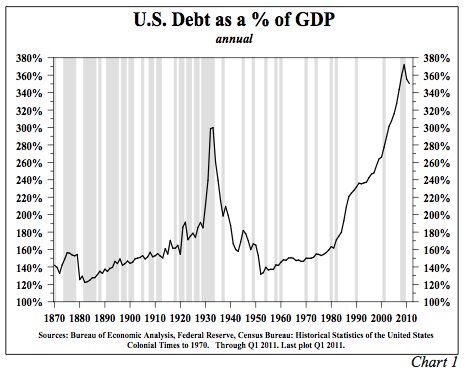
A Few Charts Depicting US Economic Woes

marketoracle.co.uk
Marketoracle.co.uk

marketoracle.co.uk

Wednesday, July 20, 2011

Presenting Things You Buy That Used to Be Free


MSN- Liz Weston

Accessing Your Own Money
You may not believe it, my dears, but banks once actually paid you for the privilege of storing your money. No, I'm not talking about the toasters that banks would give you for opening an account. I'm talking about interest, and receiving it was a wonderful thing: Your balance could grow with no effort on your part.

Banks still purportedly pay interest, but you'll need a magnifying glass to spot the difference in your account balance. Meanwhile, most financial institutions are intent on whittling away at your balance in every way they can think of -- through monthly account fees, ATM fees, fees for having a statement printed or the image of an old check retrieved, even fees for talking to a teller.

You don't have to let them rob you blind, of course. You can still get free checking at most big banks by maintaining a certain balance or agreeing to an all-electronic account (no paper statements, no talking to tellers). Or you can expand your search to community banks and credit unions, which often still offer free checking. Avoiding ATM fees can be as simple as drawing money from your own bank's machines or asking for cash back when using your debit card.